
Checks
Biodiversity net gain cost check for any site
Map the habitat on the site and see what biodiversity net gain costs under each layout option, before you buy.
In short
LandBuyer AI maps tree canopy and ground cover on the site, applies stated habitat and price assumptions, and returns a biodiversity net gain cost range for the layout you select. You compare retain, proposed and clear options side by side. On Kew Yard the proposed layout carries an allowance of £197,000 to £418,650, excluding VAT.
What it covers
What our biodiversity net gain check covers
| Item | Source type | What you see |
|---|---|---|
| Canopy and vegetation | Satellite derived tree cover and ground cover maps | Predicted canopy by height band, the share of the site it covers and the area in m² |
| Habitat baseline | Mapped ground cover with buyer adjustments | Broad wooded cover, grassland, built-up and bare ground in hectares, which you can edit |
| Buying allowance | Stated habitat and price assumptions | A cost range for the selected layout, excluding VAT |
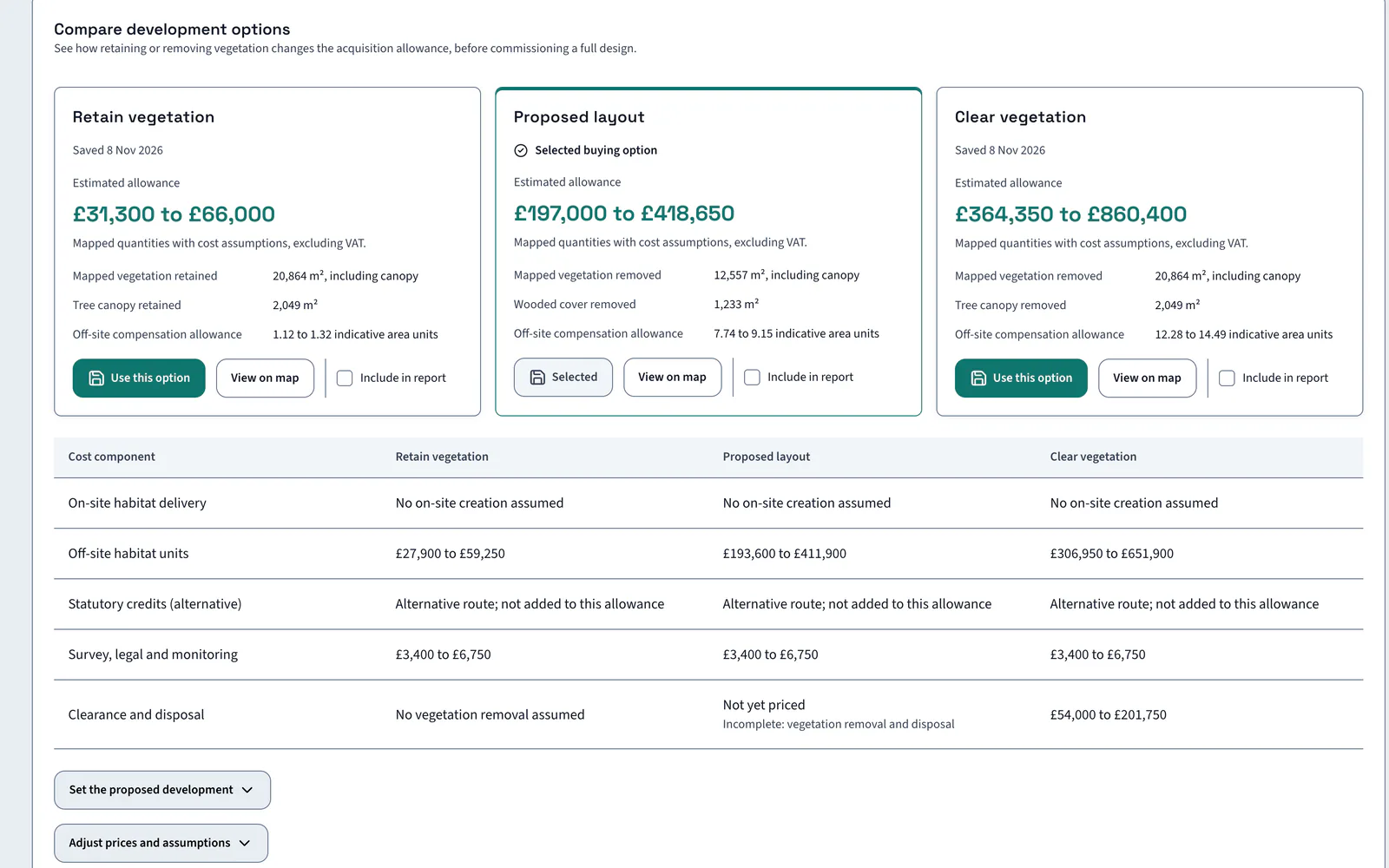
| Development options | The same assumptions applied to each option | Retain vegetation, the proposed layout and clear vegetation side by side |
| Cost components | Stated assumptions | Off-site habitat units, statutory credits as an alternative, survey and legal costs, clearance and disposal |
| Statutory designations | Nature designation datasets | Protected sites, ancient woodland, special areas of conservation, Ramsar wetlands and nature reserves |
| Nutrient catchments | Nutrient neutrality catchment maps | Whether the site lies in a catchment with a nutrient neutrality requirement |
| Off-site supply | Register of biodiversity gain sites | Registered gain sites within 40 km and the distance to the nearest |
| Requirement for the parcel | Planning application requirements | The surveys and any exemption to confirm for this parcel |
Official guidance Biodiversity net gain guidanceThe statutory biodiversity metric
On Kew Yard
Three options, three costs
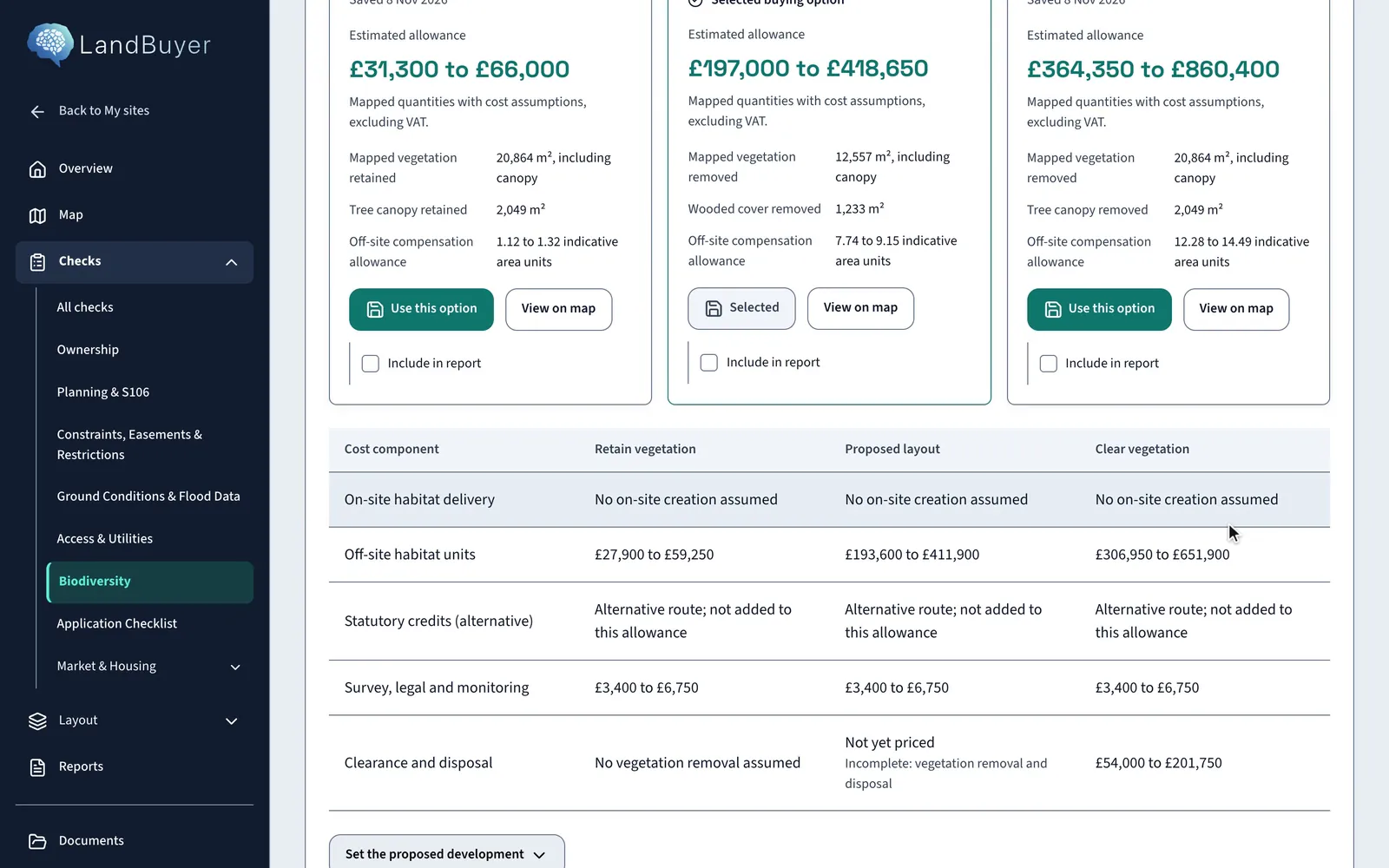
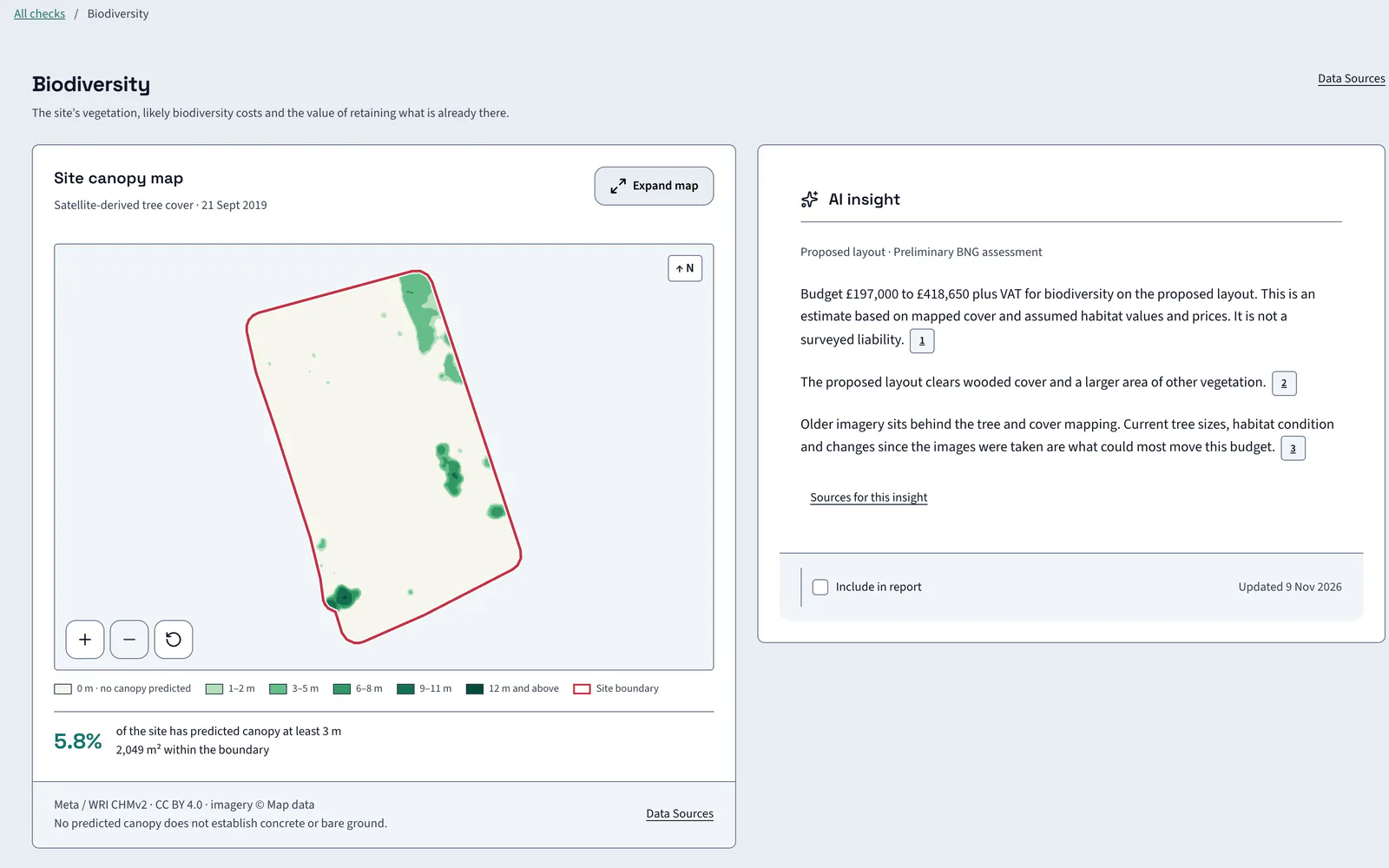
Kew Yard has 2,049 m² of mapped tree canopy, 5.8% of the site. Retaining all vegetation is the lowest cost option.
AI insight
The saved proposed layout scenario carries a preliminary allowance of £197,000 to £418,650, excluding VAT. It is an estimate built on stated habitat and price assumptions, not a surveyed liability or supplier quote.
In the report
The allowance goes into the report with its assumptions
Tick Include in report on the buying summary or on any option. The allowance, its assumptions and the AI reading go into the planning appraisal, with the imagery date beside the map.
FAQ
Biodiversity net gain questions
Short answers to what land teams ask us before a demo.
How does LandBuyer AI estimate biodiversity net gain costs?
It maps tree canopy and ground cover on the site, applies stated habitat and price assumptions and returns a cost range for your layout, excluding VAT. It is an acquisition estimate, not a surveyed liability or supplier quote.
Is this a BNG metric calculation?
No. It is a preliminary buying allowance built from mapped cover. It does not replace a surveyed habitat baseline from a qualified ecologist.
Can I test different layouts?
Yes. Three options compare retaining vegetation, the proposed layout and clearing it. On Kew Yard they run from £31,300 to £66,000, £197,000 to £418,650 and £364,350 to £860,400.
Does clearing vegetation remove the obligation?
No. Clearance is costed against the original habitat baseline, so removing vegetation does not remove the biodiversity obligation. The screen states this beside the options.
When does biodiversity net gain apply?
Mandatory biodiversity net gain applies to planning permissions on applications made from 12 February 2024. From 6 August 2026, sites of 0.2 hectares or less are exempt. Significant onsite gains are maintained for at least 30 years.
What is the BNG metric?
The statutory biodiversity metric scores habitat in biodiversity units before and after development, for the planning application. LandBuyer AI gives an earlier buying allowance from mapped habitat cover, before an ecologist surveys the site.
Keep exploring