
Checks
Restrictive covenants and easements on property
Read the restrictive covenants, easements and rights over a property, with the standoffs to design to, before you commit to a layout.
In short
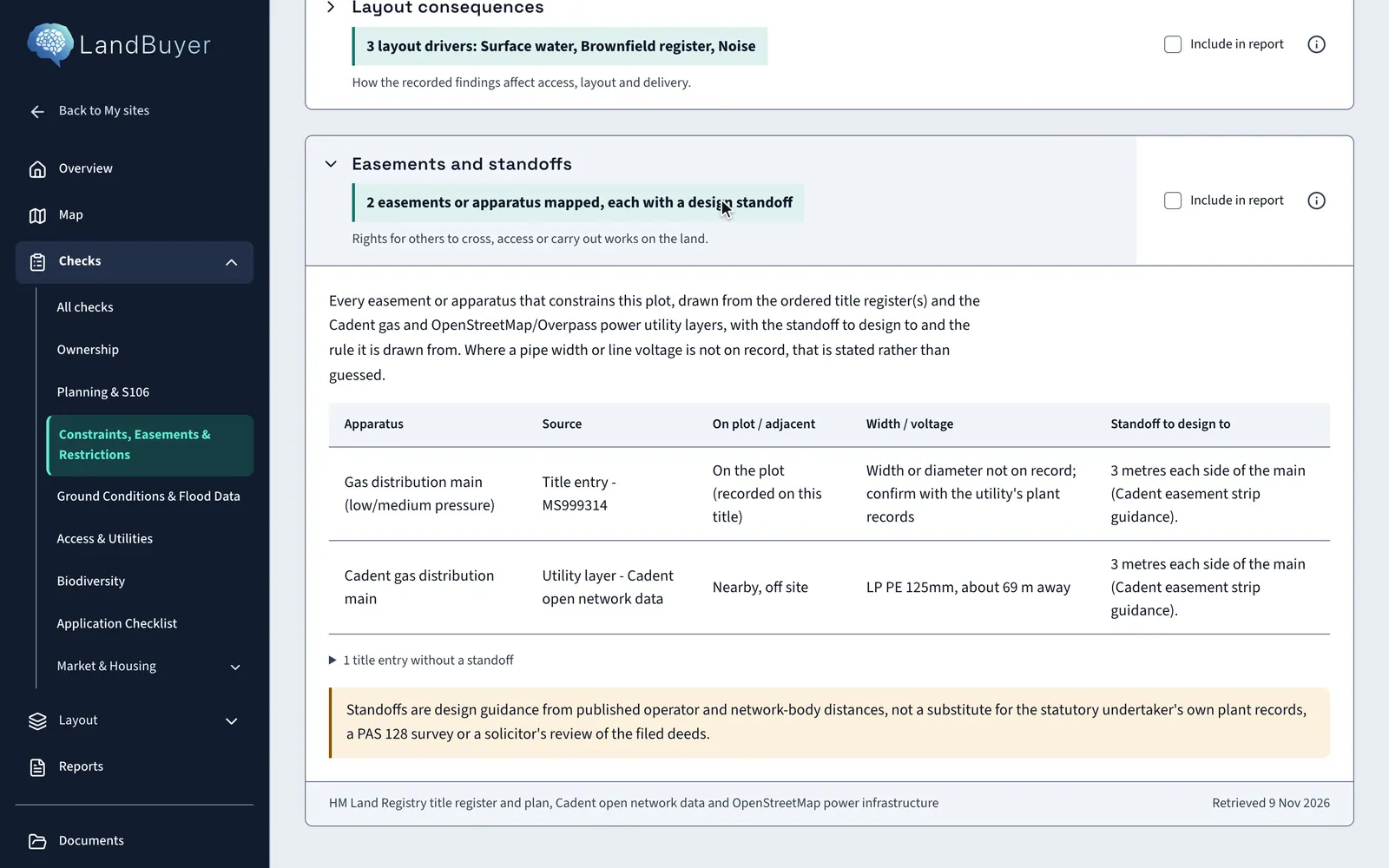
LandBuyer AI reads the title register and plan, quotes each restrictive covenant, lists every easement with its width and the deed that reserved it, and adds mapped gas and power apparatus with a design standoff. An AI insight states the layout impact. On Kew Yard it finds a covenant that bars dwellings and a 4 m services strip.
What it covers
What our covenant and easement check covers
| Item | Source type | What you see |
|---|---|---|
| Restrictive covenants | Title registers and schedules | The covenant wording, its date and whether it limits use, density or building |
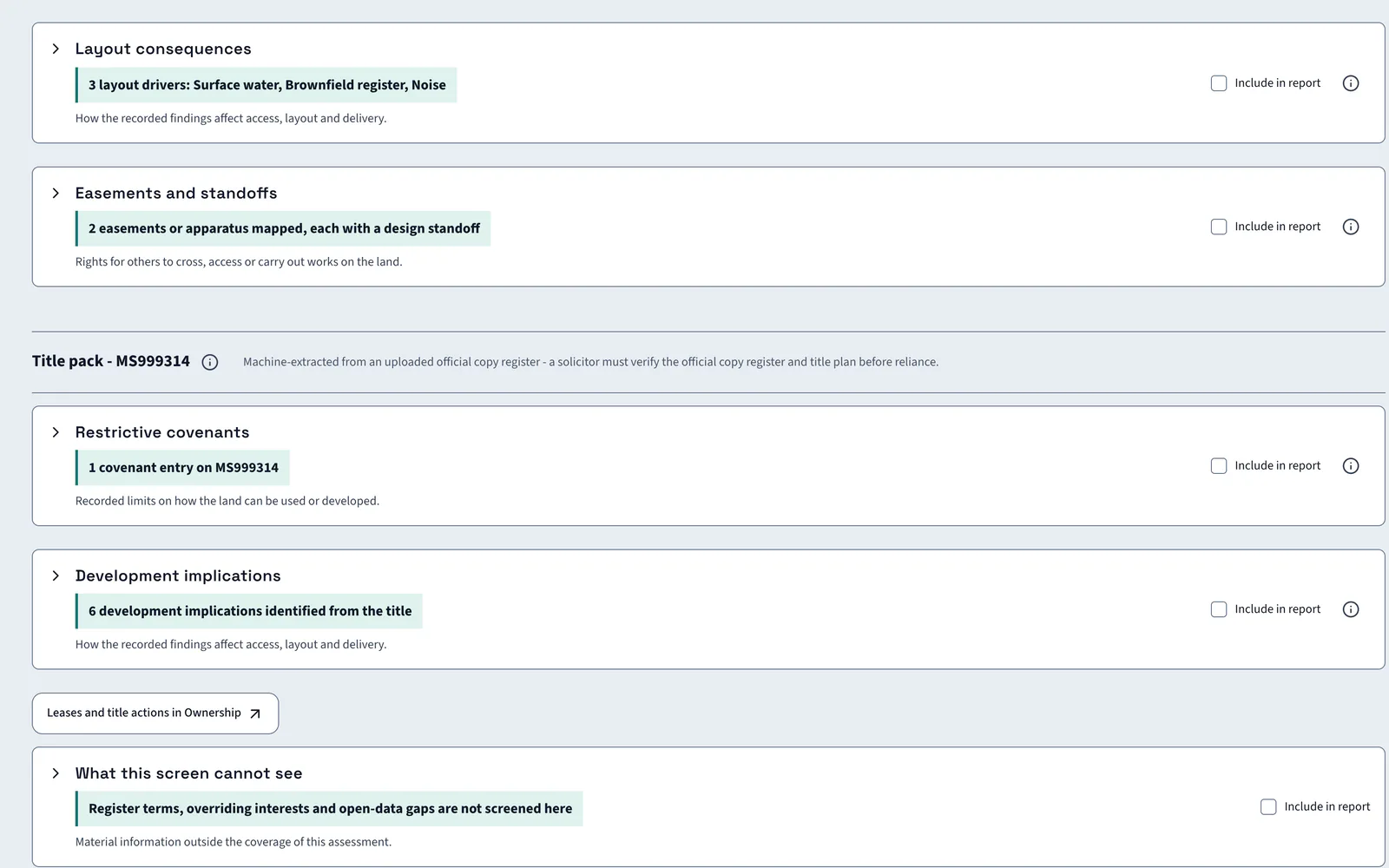
| Easements over the land | Charges register entries | Rights of drainage, services and access, with the strip width and the deed that reserved them |
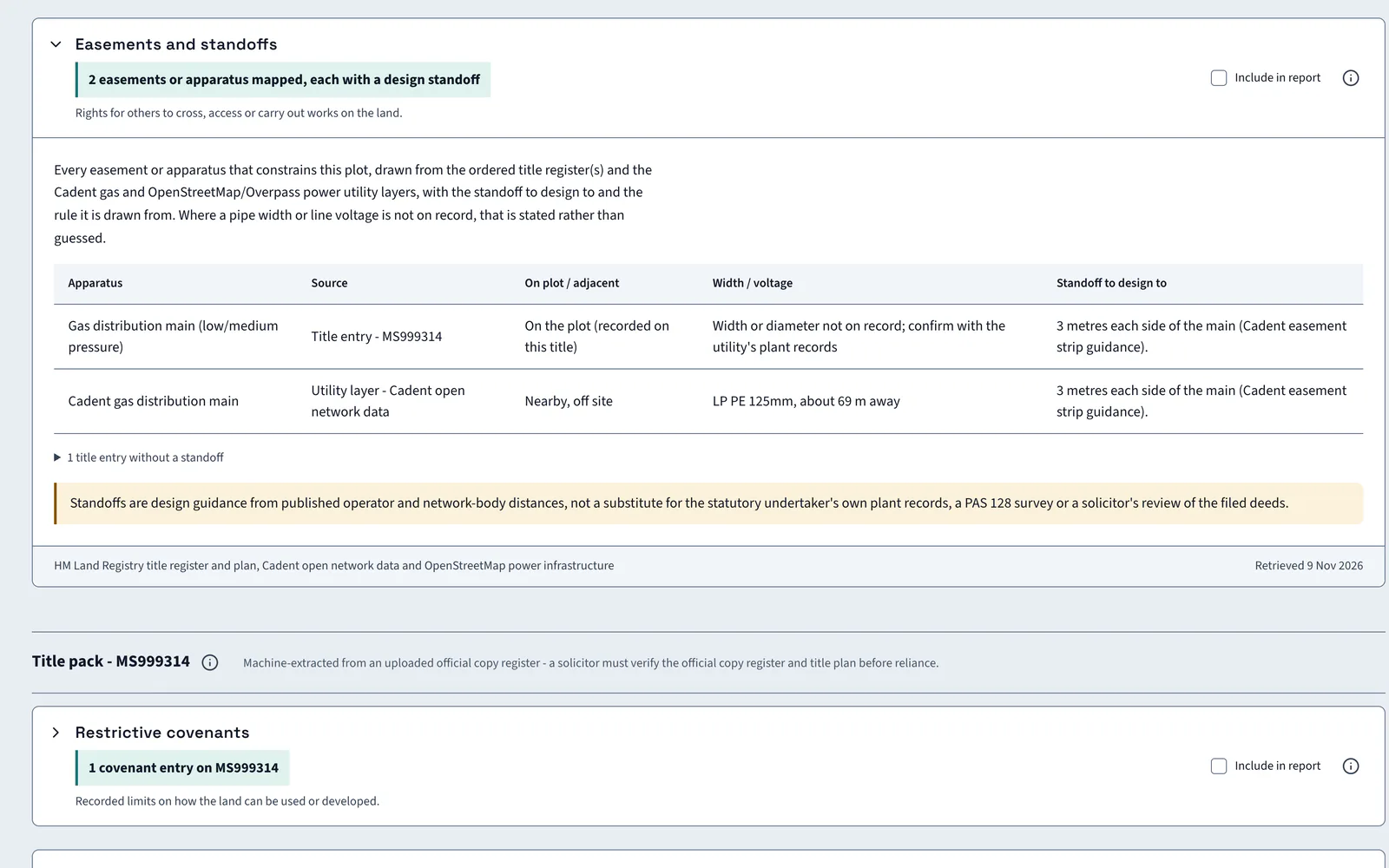
| Mapped apparatus | Gas and power utility layers | Gas mains and power lines near the plot, with pipe width or line voltage where recorded |
| Design standoffs | The rule drawn from each easement or apparatus | The distance to keep buildings back, and the rule it comes from |
| Restrictions and charges | Title registers | Lender consent and other conditions on a sale, and charges a buyer must deal with |
| Notices and options | Title registers | Unilateral notices and options that protect a third party |
| Rights of way | Title registers and mapped public paths | Rights of access in the title and any public right of way. The access check holds the full search |
| Development implications | AI reading of the title | Each recorded item turned into a consequence for access, layout and delivery |
| Title pack | Official copy register and title plan | The register and plan read together, with each easement marked as on the plot or adjacent |
Official guidance Section 84, Law of Property Act 1925Upper Tribunal guide to form T608HM Land Registry property search
On Kew Yard
A covenant against housing and a strip to design around
Kew Yard has four title issues. The covenant decides the deal and the services strip decides the layout.
AI insight
The recorded covenant limits use to a light industrial workshop or store and prohibits any dwellinghouse. A 4 metre drainage and services strip, reserved by a Transfer dated 9 July 2021, constrains where buildings and levels can sit.
In the report
Covenants and standoffs go into the report
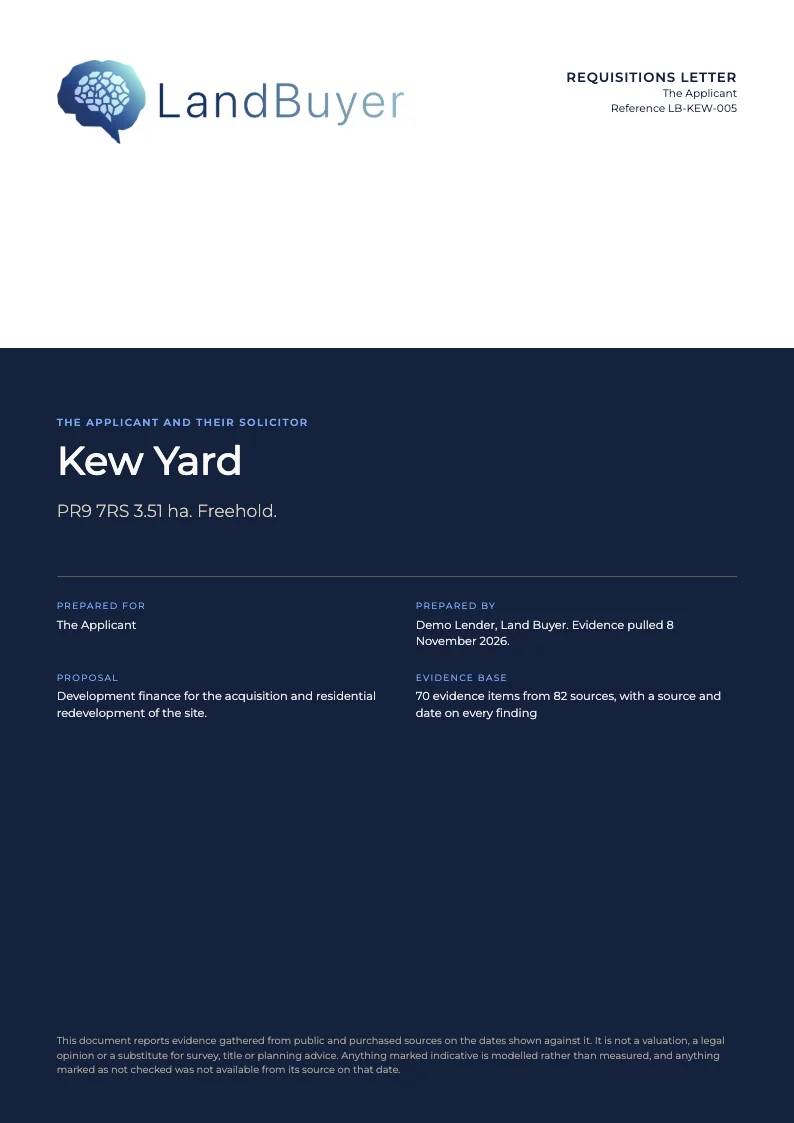
Tick Include in report on any covenant or easement card. The wording and the AI reading go into the report you choose, such as a requisitions letter to the applicant's solicitor, with the register entry beside each point.
FAQ
Restrictive covenant and easement questions
Short answers to what land teams ask us before a demo.
What is a restrictive covenant on land?
A restrictive covenant is a recorded limit on how land can be used or built on. LandBuyer AI quotes the wording from the title register, shows its date and states whether it limits use, density or building.
How do I find easements on a title?
LandBuyer AI reads the charges register and lists each easement with its width and the deed that reserved it. It also shows whether each one sits on the plot or beside it.
Does it replace a solicitor's review?
No. The screen states that a solicitor must verify the official copy register and title plan before reliance. LandBuyer AI keeps the original wording so each point is quick to check.
What is a design standoff?
A design standoff is the distance to keep buildings from an easement or apparatus. Each item on Kew Yard carries its standoff and the rule it is drawn from.
Can a restrictive covenant be removed?
In some cases. The Upper Tribunal (Lands Chamber) can discharge or modify a restrictive covenant on an application under section 84 of the Law of Property Act 1925, made on form T608.
Keep exploring