
Features
Site scoring weighted to your priorities
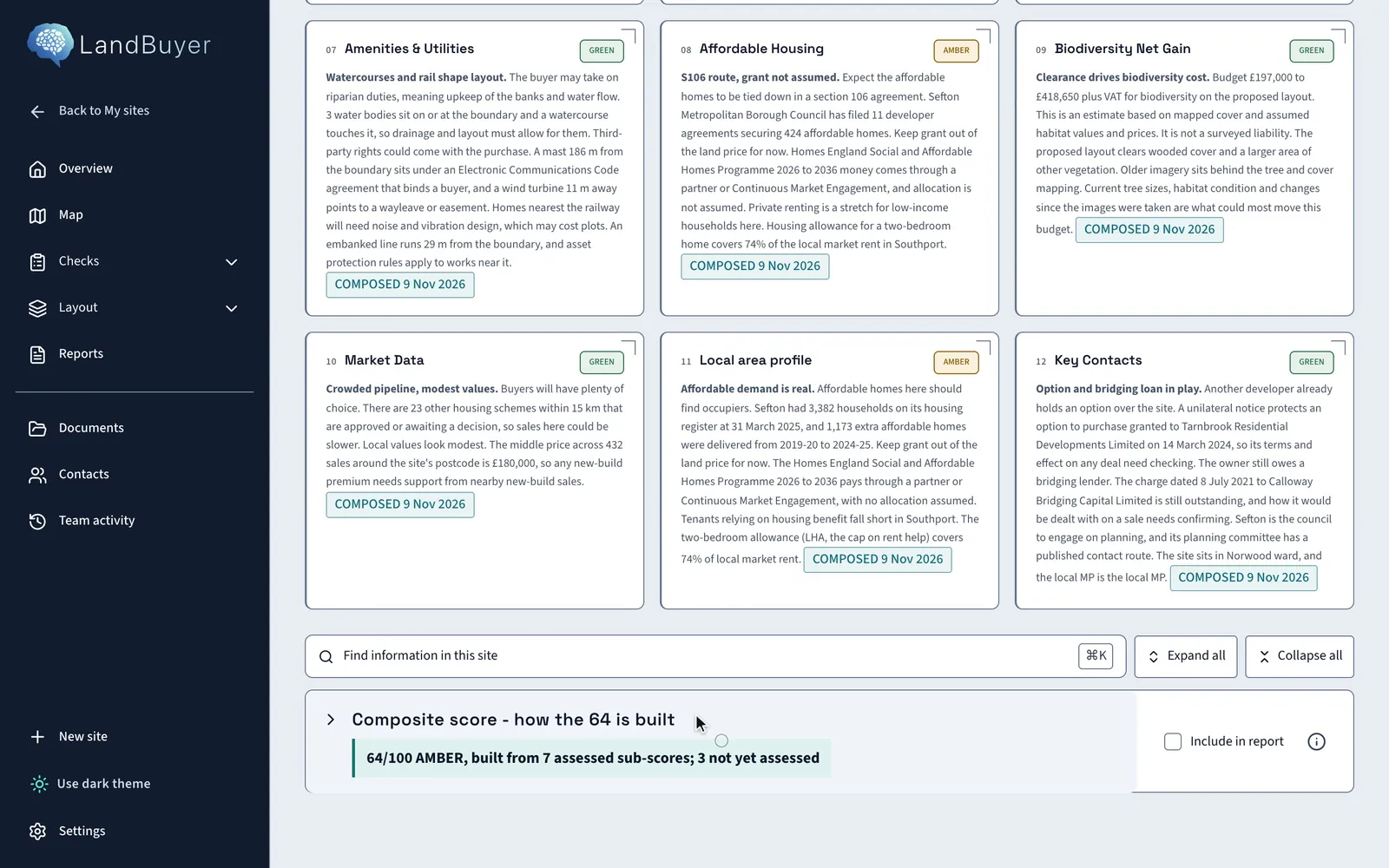
A score out of 100, module scores from weakest to strongest and a verdict your committee can read.
In short
LandBuyer AI scores each site out of 100, weighted to your company's scoring priorities. Module scores run from weakest to strongest, each marked strong, workable or weak, and the AI summary gives a viability verdict with a recommendation. Checks with no evidence earn no positive score, so gaps never flatter a site.
What it covers
What the site scoring covers
| Item | Source type | What you see |
|---|---|---|
| Site score | Saved checks and your priorities | A score out of 100, weighted to your company |
| Module scores | Each group of checks | Scores from weakest to strongest, marked strong, workable or weak |
| Evidence coverage | Saved checks | The share of evidence the score rests on, and modules not yet assessed |
| Viability verdict | AI summary | The verdict and the recommendation, with the deciding factors |
| Band key | Score thresholds | Strong at 70 and above, workable from 45 to 69 and weak under 45 |
On Kew Yard
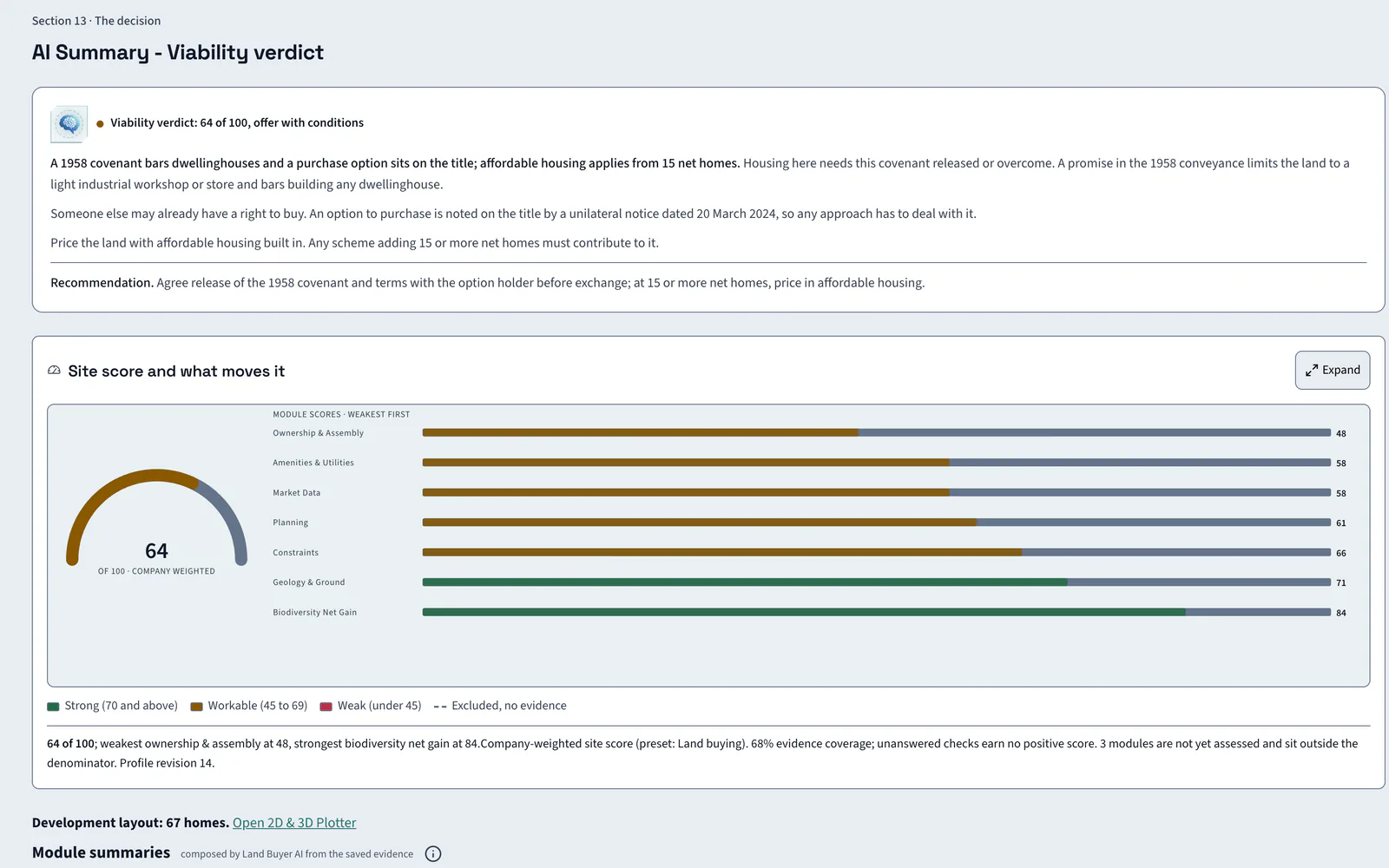
64 of 100, weakest on ownership and assembly
Kew Yard scores 64 of 100 on a land buying weighting with 68% evidence coverage. Ownership and assembly is weakest at 48.
AI insight
Establish whether the covenant has been released or modified, confirm the net dwelling count against the 15 threshold, and map surface-water extent against the boundary.
In the report
The score and verdict go into the paper
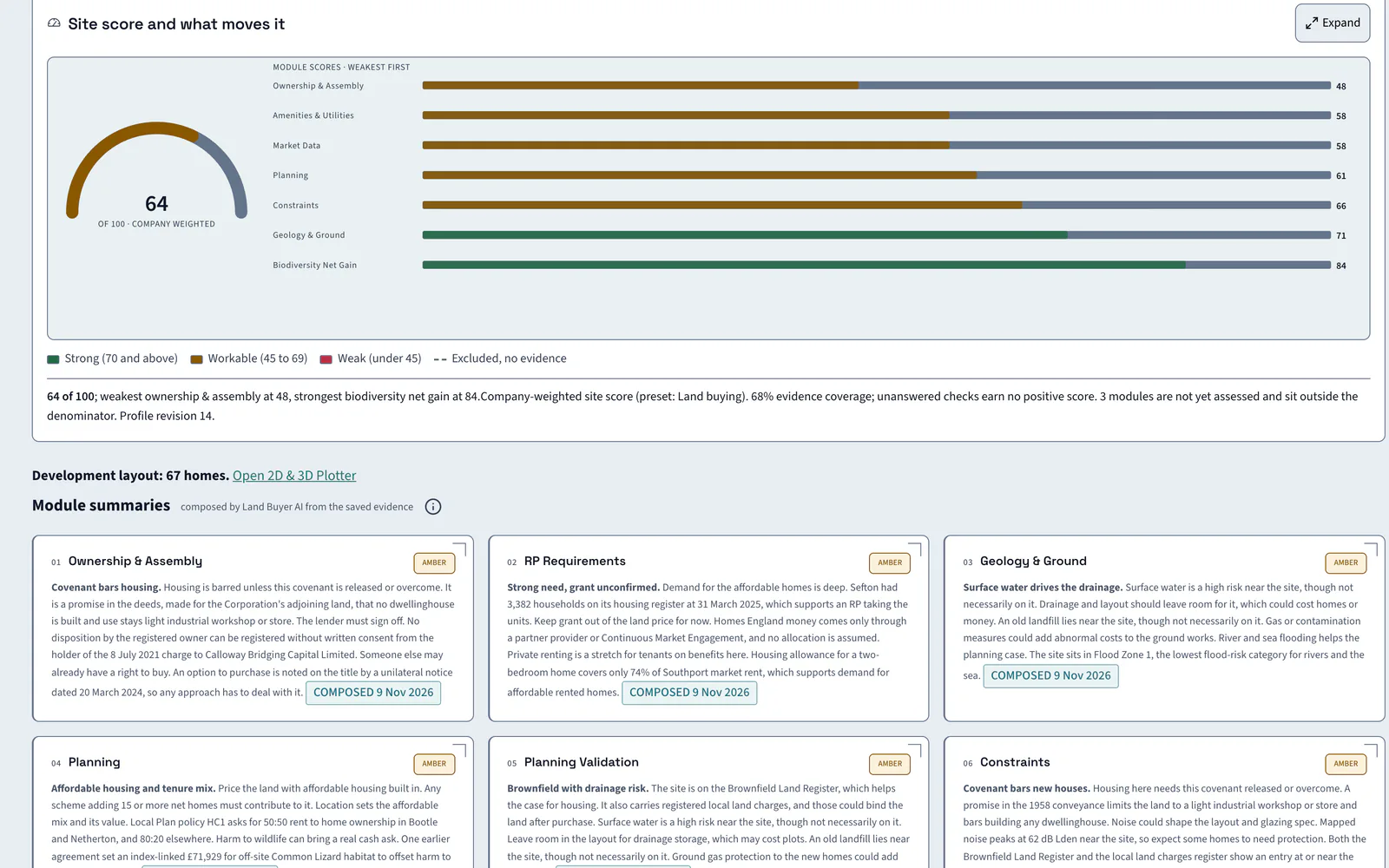
The site score, the module scores and the verdict go into the land committee paper beside the evidence that moved them, so the committee sees why the site scored as it did.
FAQ
Site scoring questions
Short answers to what land teams ask us before a demo.
How is the site score worked out?
Each module is scored from its saved checks, then weighted to your company's scoring priorities. Checks with no evidence earn no positive score, and modules not yet assessed sit outside the total.
Can we set our own priorities?
Yes. Scoring priorities are set for your company, so the score weights the modules your committee cares about most, on every site you add.
What do the bands mean?
Strong is 70 and above, workable is 45 to 69 and weak is under 45. On Kew Yard biodiversity net gain is strong at 84.
Which modules are scored?
Ownership and assembly, amenities and utilities, market data, planning, constraints, geology and ground, and biodiversity net gain. On Kew Yard three modules are not yet assessed and sit outside the total.
Keep exploring